
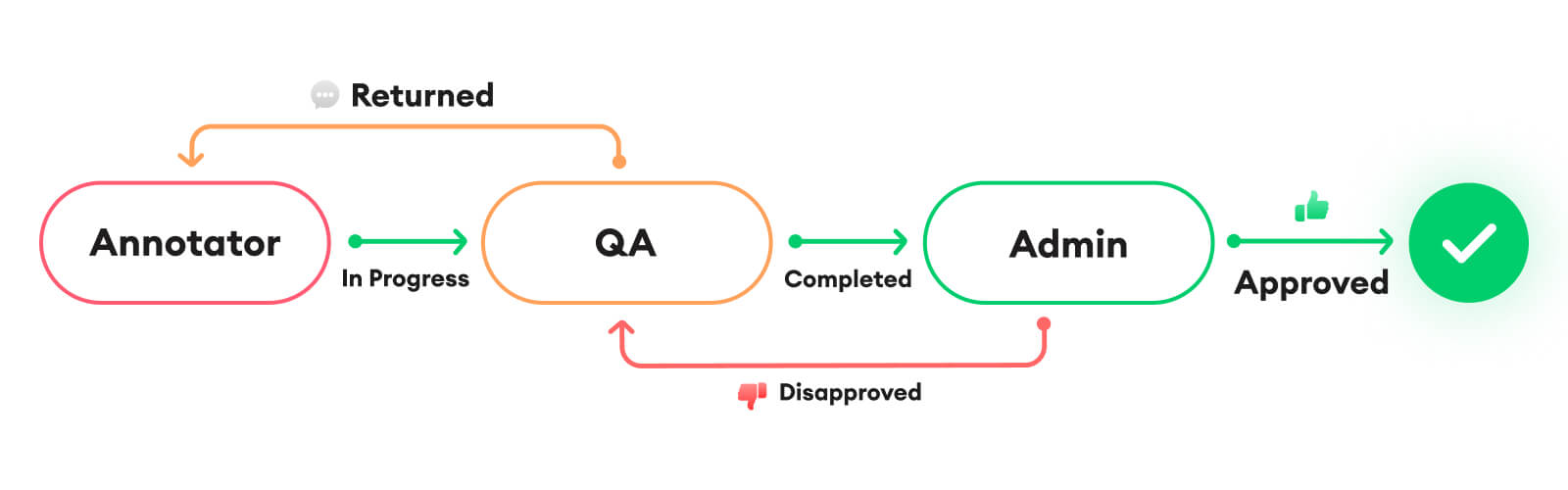
Designing an effective data annotation pipeline is crucial for building high-quality machine learning models. It’s a systematic process that ensures your data is accurately labeled, consistent, and ready for training. Here’s a breakdown of how to design your data annotation pipeline:
1. Define Your Project Goals and Requirements
Before you start annotating, clearly understand what your machine learning model needs to achieve. This initial step will guide all subsequent decisions.
- Objective Clarity: What problem are you trying to solve? What specific insights do you need from the data? For example, is it for object detection in self-driving cars, sentiment analysis in customer reviews, or medical image diagnosis?
- Data Type and Volume: What kind of data are you annotating (text, images, video, audio, LiDAR, etc.)? How much data do you have, and how much do you anticipate needing? Each data type requires a different annotation approach.
- Annotation Granularity: How detailed do your annotations need to be? Do you need broad categories, or highly specific pixel-level segmentation?
- Quality Benchmarks: Define what constitutes “high quality” for your annotations. What level of accuracy and consistency is acceptable?
- Budget and Timeline: Estimate the resources (time, money, personnel) required for the annotation project.
2. Data Collection and Preparation
The quality of your raw data directly impacts the quality of your annotations.
- Collect Relevant Data: Gather data that accurately reflects real-world scenarios and is diverse enough to prevent bias in your model. Sources can include your own databases, public datasets, web scraping, or even synthetic data. Ensure you have the necessary permissions for data usage, especially for sensitive information.
- Pre-process and Clean Data: Before sending data for annotation, clean it to remove errors, inconsistencies, duplicates, or irrelevant information. This might involve formatting, normalizing, or filtering the data.
- Analyze Data: Understand the nature of your data, identify potential biases, and ensure it represents what your model needs to learn.
3. Create Comprehensive Annotation Guidelines
Clear and detailed guidelines are paramount for consistent and accurate annotations, especially with multiple annotators.
- Clear Definitions: Define each label clearly with examples of correct and incorrect annotations.
- Annotation Rules: Specify rules for handling edge cases, ambiguous scenarios, overlapping objects, and difficult instances.
- Decision-Making Process: Outline how annotators should resolve disagreements or uncertainties.
- Iterative Updates: Be prepared to update guidelines based on feedback from annotators and insights gained during the annotation process.
4. Choose the Right Annotation Tools and Workflow
Selecting the appropriate tools is crucial for efficiency and accuracy.
- Tool Capabilities: Consider tools that support your specific data type and annotation tasks (e.g., bounding boxes, polygons, semantic segmentation, keypoints, text classification, entity recognition, transcription).
- Automation Features: Look for tools that offer AI-powered pre-labeling, active learning, or other automation features to speed up the process and reduce manual effort.
- Collaboration Features: If you have multiple annotators, choose tools that facilitate collaboration, task assignment, and progress tracking.
- Integration: Ensure the tool can integrate with your existing ML pipeline and data storage solutions.
- Open-source vs. Commercial: Evaluate open-source options like CVAT or Label Studio, or commercial platforms like Labelbox, SuperAnnotate, Scale AI, or Encord, based on your budget, security needs, and required features.
- Workflow Design:
- Manual Annotation: For complex or nuanced tasks that require human judgment.
- Machine-Assisted Labeling: Using pre-trained models to auto-label data, with humans reviewing and correcting. This significantly speeds up the process.
- Active Learning: Iteratively training a model on a small annotated dataset, then using the model to identify the most informative unlabeled data points for human annotation, thus minimizing the overall labeling effort.
5. Workforce Management (In-house vs. Outsourced)
Decide who will be doing the annotation and how they will be managed.
- In-house Team: Offers high control and domain expertise, but requires significant investment in hiring, training, and management.
- Outsourced Team/Crowdsourcing: Provides scalability and can be cost-effective for large volumes, but requires robust quality control mechanisms and clear communication.
- Training and Onboarding: Regardless of your choice, provide thorough training sessions, practice tasks, and continuous feedback to annotators. Ensure they are proficient with the tools and guidelines.
- Team Structure: Assign roles such as annotators, quality reviewers, and project leads.
6. Implement Robust Quality Control and Validation
Maintaining high annotation quality is critical for model performance.
- Inter-Annotator Agreement (IAA): Have multiple annotators label the same subset of data and measure their agreement (e.g., using metrics like Cohen’s Kappa or Fleiss’ Kappa). Low IAA indicates ambiguous guidelines or annotator issues.
- Sample Checks/Audits: Regularly review a subset of annotated data to identify errors or inconsistencies.
- Consensus Techniques: For disagreements, implement a system for reaching consensus, such as expert review, voting, or group discussions.
- Automated Quality Checks: Use scripts or built-in tool features to flag potential errors, outliers, or inconsistencies.
- Feedback Loops: Establish a continuous feedback loop between annotators, quality reviewers, and project managers to address issues, clarify guidelines, and improve the process.
- Error Analysis: Analyze the types of errors being made to refine guidelines or provide additional training.
7. Iterate and Refine
Data annotation is rarely a one-off process. It’s iterative and evolves with your project.
- Monitor Performance: Track key metrics like annotation speed, cost per label, quality scores, and annotator productivity.
- Model Evaluation and Feedback: Use the annotated data to train your ML model. Analyze model performance and identify areas where more or better annotation is needed. This feedback should inform updates to your dataset and annotation process.
- Version Control: Maintain records of all versions of your data, annotations, and quality checks.
- Adapt to New Data: As your project progresses and new data comes in, be prepared to adapt your annotation process and guidelines.
By systematically addressing each of these stages, you can design a data annotation pipeline that consistently delivers high-quality, reliable training data for your machine learning initiatives.