HOME » Page 11

Blog

  • How to Send Cold Emails and Comply With Legal Regulations

    How to Send Cold Emails and Comply With Legal Regulations

    Sending cold emails can be a powerful sales tool, but it’s crucial to follow legal regulations to avoid getting flagged as spam. Here’s a breakdown of key points to ensure your cold email outreach is compliant:

    Targeting:

    • Relevance is Key: Only reach out to prospects who would genuinely benefit from your product or service. Sending irrelevant emails is a fast track to getting marked as spam.

    Transparency:

    • Be Upfront About Who You Are: Clearly identify yourself and your company in the “From” line. Don’t try to trick recipients into thinking the email is from someone else.

    Respecting Preferences:

    • Provide an Opt-Out Option: Every email must include a clear and easy way for recipients to unsubscribe from future communications. This could be a dedicated unsubscribe link or a simple instruction like “Reply with ‘Opt-Out’ to unsubscribe.”
    • Honor Opt-Out Requests Promptly: Process unsubscribe requests within the timeframe mandated by your region’s regulations (usually 10 business days). Once someone opts out, remove them from your mailing list and don’t sell or transfer their information.

    Content and Design:

    • Avoid Misleading Subject Lines: Don’t use deceptive or click-baity subject lines to lure recipients into opening the email. Be clear and concise about the email’s content.
    • Be Honest About the Email’s Purpose: Clearly state that the email is a commercial message or solicitation.

    Additional Considerations:

    • Data Acquisition: Ensure you have a legal basis for contacting the recipient. Buying email lists from unknown sources is a bad idea. Consider methods like attending industry events or using reputable data providers that offer opt-in contacts.
    • Data Security: Store your email list securely and follow data protection regulations like GDPR (Europe) or CCPA (California) if applicable.

    Remember: Staying compliant builds trust and protects your sender reputation. By following these guidelines, you can ensure your cold email campaigns are legal and effective.

    For a deeper dive, consider researching the specific regulations in your region, such as the CAN-SPAM Act (US) or GDPR (Europe).

  • What is Audio Annotation and Segmentation audit?

    What is Audio Annotation and Segmentation audit?

    An audio annotation and segmentation audit is a process of checking the accuracy and consistency of labels and separations made in audio data. It’s essentially a quality control step for data that’s been prepared for machine learning applications.

    Here’s a breakdown of the two parts:

    • Audio Annotation: This involves attaching labels or descriptions to specific parts of the audio. These labels can describe various aspects, like:
      • Speech content (words or phrases spoken)
      • Speaker identification (who is talking)
      • Emotions conveyed in the speech
      • Background noises (traffic, music, etc.)
      • Sound events (doorbell ringing, coughing, etc.)
    • Segmentation: This refers to dividing the audio file into smaller sections based on the annotations. Each segment is then associated with the corresponding label.

    An audit ensures that the annotations and segmentations are:

    • Accurate: The labels correctly reflect the content of the corresponding audio segment.
    • Consistent: Annotators applied the labels and segmentations following the same guidelines throughout the entire dataset.
    • Complete: All relevant aspects of the audio are labeled and segmented according to the project’s requirements.

    By catching inconsistencies and errors, the audit helps improve the quality of the training data for machine learning models. This can lead to better performance and accuracy in applications like speech recognition, speaker identification, and sentiment analysis.

  • Labeling and Annotating Datasets

    Labeling and Annotating Datasets

    Labeling and annotating datasets are two closely related processes used to prepare data for machine learning, particularly supervised learning. They both involve adding information to raw data, but with some key differences:

    Data Labeling

    • Focus: Identifies the overall content or nature of the data.
    • Process: Assigns simple categories or tags to the data points.
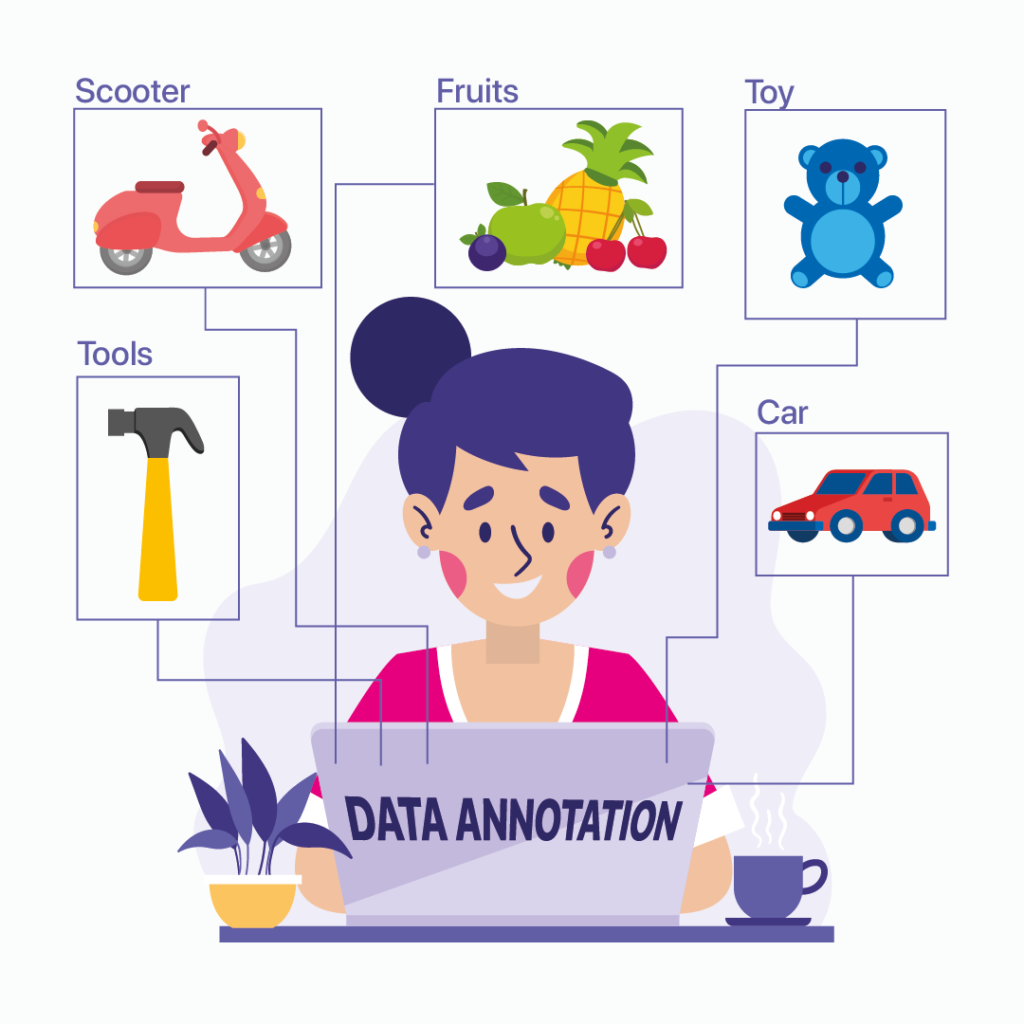
    • Imagine: Adding labels like “cat” or “dog” to images, or “spam” or “not spam” to emails.
    • Example Tasks:
      • Image recognition: Classifying objects in pictures (car, person, flower).
      • Text classification: Categorizing emails (spam, marketing, work).
      • Sentiment analysis: Labeling the sentiment of a review (positive, negative, neutral).

    Data Annotation

    • Focus: Adds more specific details and context to the data.
    • Process: Involves marking up specific elements within the data.
    • Imagine: Drawing a box around a cat in an image, or highlighting key phrases in a document.
    • Example Tasks:
      • Object detection: Creating bounding boxes around objects in images (not just identifying them).
      • Image segmentation: Labeling different regions in an image (separating the sky from buildings).
      • Part-of-speech tagging: Identifying the grammatical function of words in a sentence (noun, verb, adjective).

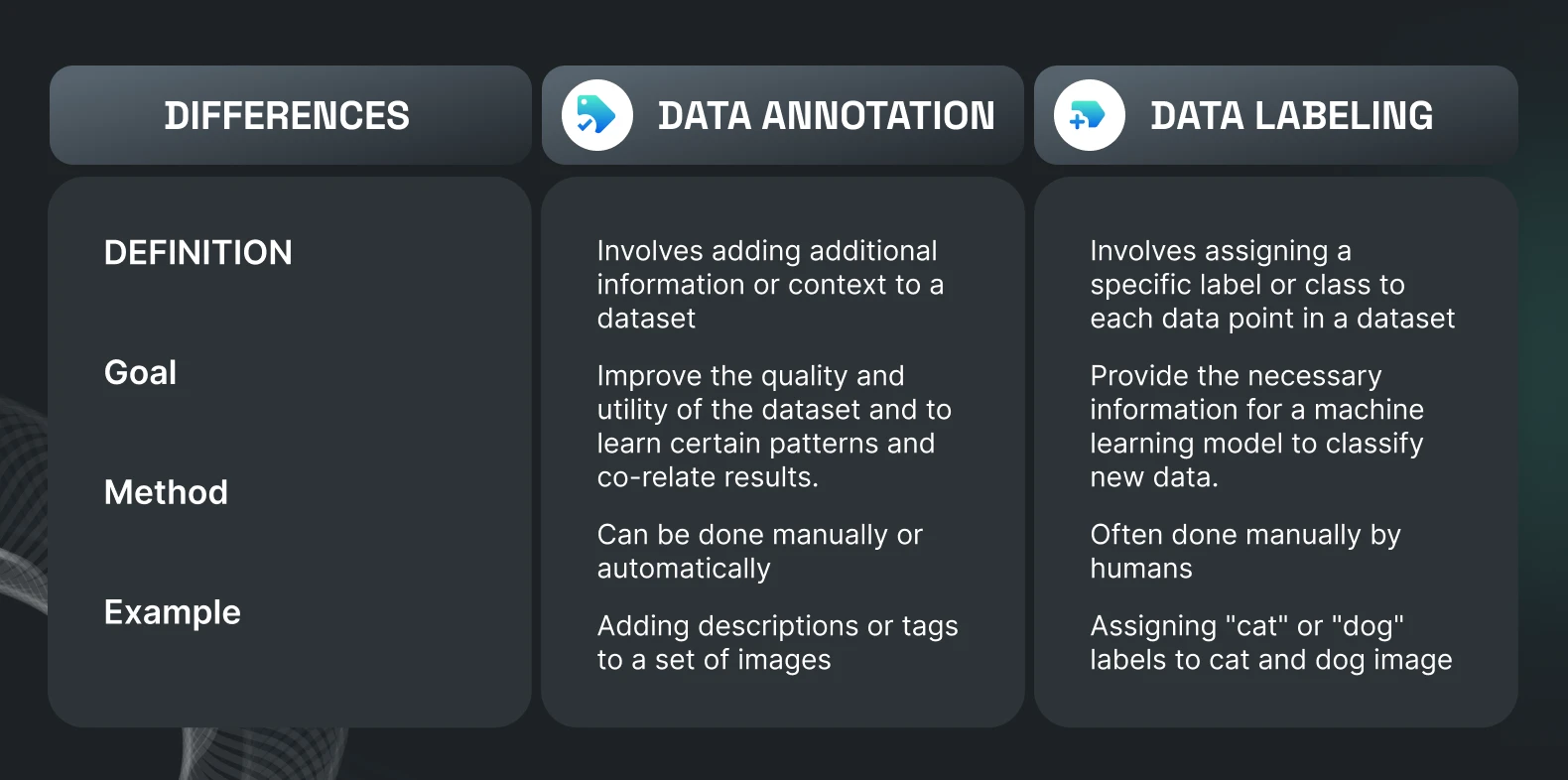
    Here’s a table summarizing the key differences:

    FeatureData LabelingData Annotation
    FocusOverall content/natureSpecific details/context
    ProcessAssigning categories/tagsMarking up elements
    Example“Cat” on an imageBounding box around a cat in an image

    Choosing the right approach depends on the type of data and the specific machine learning task. For some tasks, labeling might be sufficient. But for more complex tasks, annotation provides richer information for the model to learn from.

  • Top 5 things to look out for when selecting a data annotation provider

    Top 5 things to look out for when selecting a data annotation provider

    When choosing a data annotation provider, the accuracy of your machine learning model hangs in the balance. Here are the top 5 things to consider:

    1. Workforce Location and Diversity:
    • Look for providers with a geographically diverse workforce. This helps reduce bias in annotations and ensures better representation of the real world your model will encounter.
    1. Subject Matter Expertise and Scalability:
    • Does the provider have experience annotating data similar to yours (text, images, audio)?
    • Choose a provider that can scale their workforce up or down to meet your project’s changing needs.
    1. Quality Control Mechanisms:
    • The provider should have a robust quality control process, including multi-stage checks and inter-annotator agreement measurements.
    • Ask about their error rate and how they handle disagreements between annotators.
    1. Data Security and Compliance:
    • Ensure the provider has strong data security measures in place to protect your sensitive data.
    • Look for certifications like SOC 2 and GDPR compliance to verify their security practices.
    1. Ethical and Fair-Work Policies:
    • Choose a provider that offers fair wages and good working conditions for their annotators.
    • Unethical treatment can lead to high turnover and potentially lower quality annotations.
  • What is Amazon Rekognition and how will the data annotation agencies compete?

    What is Amazon Rekognition and how will the data annotation agencies compete?

    Amazon Rekognition is a cloud-based image and video analysis service that makes it easy to add advanced computer vision capabilities to your applications. The service is powered by proven deep learning technology and it requires no machine learning expertise to use. Amazon Rekognition includes a simple, easy-to-use API that can quickly analyze any image or video file that’s stored in Amazon S3.

    You can add features that detect objects, text, unsafe content, analyze images/videos, and compare faces to your application using Rekognition’s APIs. With Amazon Rekognition’s face recognition APIs, you can detect, analyze, and compare faces for a wide variety of use cases, including user verification, cataloging, people counting, and public safety.

    The service is based on the same proven, highly scalable, deep learning technology developed by Amazon’s computer vision scientists, technology that can analyze billions of images and videos daily. Rekognition routinely learns from new data, and we frequently add new labels and features to the service.

    READ Full Article at source: https://docs.aws.amazon.com/rekognition/latest/dg/what-is.html

    Key capabilities

    Image Analysis:

    • Object, Scene, and Concept Detection – Detects and classify objects, scenes, concepts, and celebrities in images.
    • Text Detection – Detect and recognize printed and handwritten text in images in a variety of languages.
    • Unsafe Content – Detect and filter explicit, inappropriate, and violent content and images. Detects granular unsafe content labels.
    • Celebrity recognition – Recognize tens of thousands of celebrities in your images across different categories, such as politicians, athletes, actors, and musicians.
    • Facial Analysis – Detect, analyze, and compare faces, along with facial attributes, such as gender, age, and emotions. Use cases may include user verification, cataloging, people counting, and public safety.
    • Custom Labels – Build custom classifiers to detect objects specific to your use case, such as logos, products, characters.
    • Image Properties – Analyze image properties like quality, color, sharpness, contrast.

    Video Analysis:

    • Object, Scene, and Concept Detection – Detects and classify objects, scenes, concepts, and celebrities in videos.
    • Text Detection – Detect and recognize printed and handwritten text in videos in a variety of languages.
    • People pathing – Track identified people as they move across video frames.
    • Facial Analysis – Detect, analyze, and compare faces in streaming or stored videos.
    • Celebrity recognition – Recognize tens of thousands of celebrities in your stored videos across different categories, such as politicians, athletes, actors, and musicians.
    • Unsafe Content Detection – Detect explicit, inappropriate, and violent content in videos.
    • Video segmentation – Automatically identify useful segments of video, such as black frames and end credits.
    • Face liveness – Detect if a live user is present during face verification.
  • Data Annotation for Advertising Agencies

    Data Annotation for Advertising Agencies

    Data annotation plays a crucial role in the advertising world, particularly for agencies that leverage artificial intelligence (AI) and machine learning (ML) for their campaigns. Here’s how data annotation helps advertising agencies:

    Understanding Customer Behavior and Preferences:

    • Image and Video Annotation: Agencies can annotate images and videos from ad campaigns to train ML models that recognize objects, demographics, emotions, and brand logos. This helps understand how viewers react to different ad elements and tailor future campaigns for better engagement.
    • Text Annotation: By annotating text data like customer reviews, social media comments, and survey responses, agencies can train models to identify sentiment, brand perception, and emerging trends. This allows them to create targeted messaging and address customer concerns proactively.

    Campaign Optimization and Targeting:

    • Clickstream Data Annotation: Annotating user clicks on websites or apps helps models understand user journeys and identify high-performing elements within ads. This allows for A/B testing and optimization of ad creatives for maximized conversion rates.
    • Audience Segmentation: Data annotation can be used to segment audiences based on demographics, interests, and online behavior. This enables agencies to deliver highly targeted ads to the most relevant user groups, increasing campaign effectiveness and return on ad spend (ROAS).

    Advanced Techniques and Emerging Applications:

    • Sentiment Analysis: Going beyond basic sentiment labeling, annotation can train models to understand the nuance of customer opinions, allowing for sentiment analysis on a more granular level. This helps agencies refine their messaging and build stronger brand relationships.
    • Creative Automation: Data annotation can fuel AI-powered tools that generate personalized ad creatives based on user data and campaign goals. This allows for faster iteration and dynamic ad experiences, catering to individual user preferences.

    Benefits for Advertising Agencies:

    • Improved Targeting: Data annotation leads to more precise audience targeting, maximizing campaign reach and impact.
    • Creative Optimization: Data-driven insights help agencies create high-performing ad creatives that resonate with target audiences.
    • Personalization: Agencies can leverage data annotation to personalize ad experiences for individual users, leading to higher engagement and conversions.
    • Efficiency Gains: Automated tasks powered by data annotation free up human resources, allowing teams to focus on strategic aspects of campaigns.

    How Advertising Agencies Can Use Data Annotation

    • Agencies can build in-house data annotation teams with the expertise to label data relevant to their specific advertising needs.
    • Partner with external data annotation service providers who specialize in tasks like image/video labeling or text categorization.
    • Utilize data annotation platforms that offer tools and workflows specifically designed for the advertising industry.

    By embracing data annotation, advertising agencies can unlock a wealth of insights from data, leading to more effective and data-driven advertising campaigns.

  • Why is Audio / Speech Annotation Services needed for NLP?

    Why is Audio / Speech Annotation Services needed for NLP?

    Audio/Speech annotation services are crucial for NLP (Natural Language Processing) because they bridge the gap between spoken language and the world of machines. Here’s why they are essential:

    • Machine Learning for Speech Recognition: NLP relies on machine learning models to understand and process human language. These models require vast amounts of labeled speech data to learn and improve their accuracy in recognizing spoken words. Audio annotation services provide this labeled data by segmenting and tagging speech with relevant information.
    • Understanding Nuances of Speech: Spoken language goes beyond just words. Speech annotation captures additional details like tone, emotion, background noise, and even speaker characteristics. This nuanced data allows NLP models to understand the full context of a conversation, leading to more accurate and natural interactions with machines (like virtual assistants or chatbots).
    • Training for Different Accents and Dialects: Human speech varies greatly depending on accents and dialects. Audio annotation services can provide data that reflects this variety, enabling NLP models to handle diverse speech patterns and improve their overall comprehension.
    • Beyond Just Words: Speech annotation isn’t limited to spoken words. It can also encompass labeling sounds from the environment (traffic noise, music) or even non-verbal cues like laughter or coughing. This enriched data allows NLP applications to be more versatile and understand the broader soundscape of human communication.

    In essence, audio/speech annotation services provide the “training wheels” for NLP models when it comes to speech recognition. By providing high-quality labeled data, they enable NLP to bridge the gap between the spoken word and the digital world.

  • How does Google Gemini work?

    How does Google Gemini work?

    Gemini is the AI-powered assistant from Google, built right into Gmail, Docs, Sheets and more, with enterprise-grade security and privacy.

    Gemini gives you direct access to Google AI. Get help with writing, planning, learning and more.

    How Gemini works

    The simple answer

    When you enter a prompt into Gemini, it replies with a response using the information that it already knows or fetches from other sources, such as other Google services.

    The technical answer

    Gemini gives you access to large language models

    • The language models learn by ‘reading’ trillions of words that help them pick up on patterns that make up language. This allows them to pick up on and reply to your questions using common language patterns
    • They are always learning, which means that they also learn from your prompts, responses and feedback
    • Gemini will make mistakes and might even say something offensive

    Ways to use Gemini

    Here are some prompt examples that you can try out:

    • ‘Explain projectile motion using everyday examples’
    • ‘Which came first: the chicken or the egg?’
    • ‘Help me brainstorm a title for my short story’

    Gemini isn’t human

    It doesn’t have its own thoughts or feelings, even though it might sound like a human. Remember:

    • Gemini can’t replace important people in your life, such as family, friends, teachers or doctors
    • Gemini can’t do your work for you
    • Gemini can’t make important life decisions for you

    Want to know more?

    Get to know the tech behind Gemini through this essential reading list

  • What is Audio Annotation and Segmentation audit?

    What is Audio Annotation and Segmentation audit?

    An audio annotation and segmentation audit is a process of checking the accuracy and consistency of labels and separations made in audio data. It’s essentially a quality control step for data that’s been prepared for machine learning applications.

    Here’s a breakdown of the two parts:

    • Audio Annotation: This involves attaching labels or descriptions to specific parts of the audio. These labels can describe various aspects, like:
      • Speech content (words or phrases spoken)
      • Speaker identification (who is talking)
      • Emotions conveyed in the speech
      • Background noises (traffic, music, etc.)
      • Sound events (doorbell ringing, coughing, etc.)
    • Segmentation: This refers to dividing the audio file into smaller sections based on the annotations. Each segment is then associated with the corresponding label.

    An audit ensures that the annotations and segmentations are:

    • Accurate: The labels correctly reflect the content of the corresponding audio segment.
    • Consistent: Annotators applied the labels and segmentations following the same guidelines throughout the entire dataset.
    • Complete: All relevant aspects of the audio are labeled and segmented according to the project’s requirements.

    By catching inconsistencies and errors, the audit helps improve the quality of the training data for machine learning models. This can lead to better performance and accuracy in applications like speech recognition, speaker identification, and sentiment analysis.

  • Data Annotation vs Data Labeling: Which is Right for You?

    Data Annotation vs Data Labeling: Which is Right for You?

    Data annotation and data labeling, though often used interchangeably, are distinct processes that serve different purposes in training machine learning models. Here’s a breakdown to help you choose the right approach for your project:

    Data Labeling

    • Focus: Categorization and organization.
    • Process: Assigning labels to data points, like classifying an image as “cat” or a text document as “spam.”
    • Use Cases: Well-suited for tasks with predefined categories, like sentiment analysis (positive, negative, neutral) or image classification (car, dog, flower).
    • Complexity: Generally less complex, requiring identification of key features for categorization.
    • Scalability: More scalable for large datasets due to its simpler nature.

    Data Annotation

    • Focus: Adding depth and context.
    • Process: Involves detailed marking or tagging specific elements within the data. This could be drawing bounding boxes around objects in an image, segmenting different regions, or pinpointing keypoints in an image.
    • Use Cases: Essential for complex projects requiring nuanced understanding, such as object detection (identifying and locating objects within an image) or image segmentation (labeling every pixel in an image).
    • Complexity: More intricate and requires a deeper understanding of the data and the task at hand. Annotators often need to make judgments and provide context-rich annotations.
    • Scalability: Can be time-consuming for large datasets due to the level of detail involved.

    Choosing the Right Approach

    • Project Complexity: For straightforward classification tasks, data labeling might suffice. For projects demanding in-depth analysis, data annotation is crucial.
    • Data Type and Volume: The type and amount of data you’re working with also play a role. Large datasets with diverse data types (images, text, audio) might require a combination of both labeling and annotation for optimal model training.

    Ultimately, the best approach depends on your specific project requirements. By understanding the distinction between data annotation and data labeling, you can make an informed decision to ensure your machine learning model is trained on high-quality data.